
USF Women’s Hoops did great. Again. Let's not abandon them now.
In the new era of college athletics, non-revenue sports are going to get hit hard. But one at USF should avoid the guillotine.

USF Women’s Basketball is a huge source of pride for an athletic program that has a history of often falling short. The 2025 Bulls entered their 10th NCAA Tournament in 20 years, and their ninth in the past 13 seasons, with something they’ve only done once before: A conference tournament championship trophy.
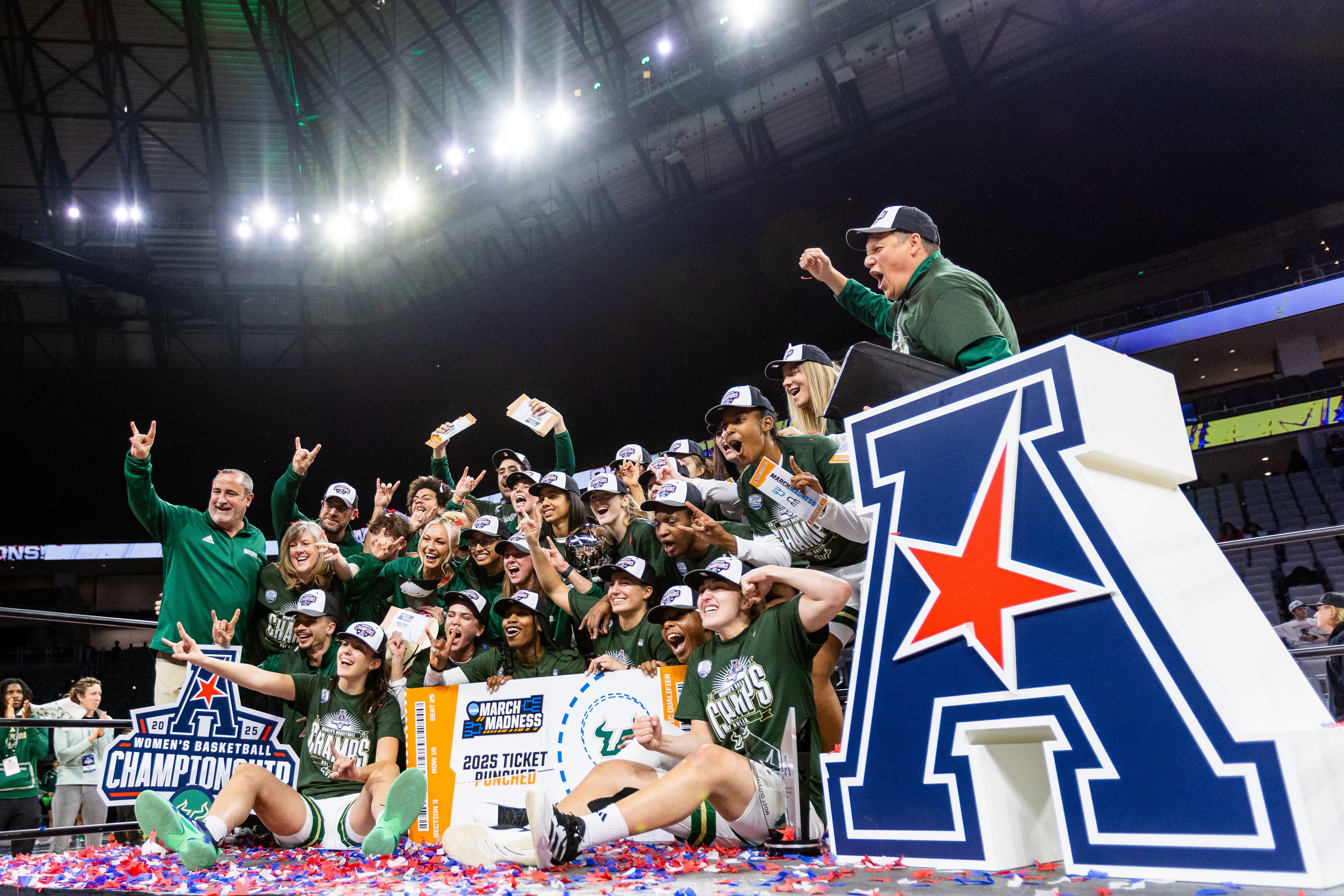
With three wins as the No. 3 seed in Fort Worth, the Bulls cut down the nets for just the second time in 50 years of competition. And since the history of the program is littered with so many Top 25 teams that got UConn’d, this was the first team that needed an automatic bid.
The 2021 Bulls would have been an NCAA at-large if they didn’t win the first available non-Huskies AAC title, thus 2025’s No. 12 NCAA seed was the lowest-ranked Dance Card in program history.
And for their efforts, they watched an 8-8 SEC team come at them for 40 minutes in an unending morass of arms, legs, and three-pointers. No. 5 Tennessee put 13 players on the court in Columbus. They substituted all five players on the floor multiple times, something head coach Kim Caldwell told me postgame is the vision for her program even after her rookie season in Knoxville.
The Lady Vols were 16-37 from three-point range against the Bulls. They forced 24 turnovers, with 10 coming in the first 10 minutes. Six players over six feet tall made a three-pointer. Their length and size and speed wore down a Bulls team that simply didn’t have the depth to compete. “We got in their legs,” said Caldwell, whose waves of bodies turned a one-point game after the first quarter into a 21-point pre-thrashing by intermission, and a 101-66 final at Value City Arena on Friday night.
So that happened, despite a brilliant 28-point performance from Sammie Puisis in her swan song. And this wasn’t a fluke, as the Vols went on to dust No. 4 seeded Ohio State two days later on their home floor.
Head coach Jose Fernandez made it clear he was going to ride with his best five players.
“The guys that played tonight were the ones that deserved to play, that have been doing the right things at practice, that have been good teammates, that have been good in preparation,” Fernandez said post-game.
But while watching the Bulls, who finish the season ranked 70th overall by HerHoopsStats (the KenPom of the women’s game) get mauled by the 11th-rated Lady Vols, it was impossible to not wonder if this is the future of college athletics in the NIL Era: An FBS-but-non-Power Four team just not being able to hang against more players, and more good players, because of a significant payroll disparity.
The chalk was 28-4 in the first round of the 2025 NCAA Women’s Tournament. The four upsets were two 8/9 games and two 10/7 games. And most of the 28 favorite wins had score lines that looked pretty similar to USF’s in Columbus. The gap between the haves and the have-nots of women’s college basketball was already wide. The UConn’s and Baylor’s and South Carolina’s and LSU’s were already head and shoulders above their peers. Now they’ve got the checkbooks to back it up too.
So what should the expectations be of a non-P4 program, one with a terrific tradition and fan support relative to both peer schools and conference opponents, when most of the money is going to football?
Is the ceiling lower than it was before? Are the days of the Bulls spending a good portion of the season in the Top 25 a relic of the past? Will those famously-difficult Jose Fernandez non-conference schedules now see more losses due to an inability to acquire the best talent when total free agency is never more than six months away?
For that I don’t have answers. But I’d say throwing out the playbook for what has been a quarter-century of success would be pretty short-sighted. And that playbook has been to find the best players available in Europe and other places abroad, with as many that have youth national team experience as possible, and put them in a system that forces them to get better in terms of both skill and conditioning.
Players across the ocean know about NIL now too. “It's definitely changed. Now they all have representatives and agents now, which is unfortunate because education for a lot of the international student-athletes in regards to shared revenue and NIL is not there,” Fernandez told me post-game. “It's really disappointing to see some of the stuff that's going on.”
The Bulls accepting the status quo and a mid-major fate doesn’t seem like the correct answer either. USF Women’s Basketball is a brand that means something to the institution. It’s why they’ve been Top 25 in attendance nationally for years; a list usually filled with schools surrounded by frozen cow pastures instead of sun-drenched golf courses.
But every dollar spent on bringing in the best talent is one taken away from both a football team desperate to claim a conference championship of their own, and perhaps more importantly for the gleaming new facility in which they’ll play.
--
USF women’s basketball has given me more joy than any other team on campus the last 25 years, and it’s not particularly close. Volleyball will always be my favorite despite them not getting to an NCAA Tournament since I was skipping class to watch them play. There have been two really fun men’s basketball seasons (2012, 2024), and 23 that basically blend together except for the quality of opponent to whom we were losing.
RIP MSG, I’ll never, ever forget you. ‘Tis better to have loved and lost…
Baseball has perpetually underperformed outside of some bright spot seasons, one of which I’ll treasure forever. But both soccer teams have found long stretches of success and hardware. And while we’ve seen tennis and men’s golf and track teams win titles that very much matter as to how you should assess the value of a collegiate athletic enterprise, they don’t sell season tickets for those sports.
Of course football is the rising tide that lifts all ships even if they haven’t lifted a league trophy yet. Football is how athletic directors get judged, how revenue is raised, and it remains the only path out of the current conference situation.
So if Michael Kelly and Will Weatherford gave me the budget steering wheel, a decision I can assure you they’d regret when we’d have SID’s making $250k a year, I’d continue to invest USF’s limited resources into women’s basketball. I’d want some revenue spent to continue to compete as a Top 25 team, even if it cost me depth at right guard or b-backer.
But that’s because of how I view what should be the priorities of USF Athletics. A public institution’s Division I athletics program should not be judged only by the bottom line. College sports need to exist for the non-financial benefit of their communities and stakeholders as well.
A McKinsey consultant would probably tell a school in USF’s boat that they should “optimize” their athletic success by pouring every dollar into football and men’s basketball. Let every other sport fend for themselves on subsistence wages, because when the SEC is paying out $52.5 million per school before they sell a ticket or a sponsorship, and the AAC is sending you only $7 million, you’ve got to put all the eggs in the basket of sports that can make you more money in the long-term.
And you can also lose your soul in that process.
Not every dollar spent on women’s hoops is lost, as there’s a waiting list for courtside season tickets for a reason. As much as any non-P4 program, USF women’s basketball still generates plenty of revenue. It might not be to break even when the distributed NIL dollars are involved, but it does bring in money that makes a difference to the bottom line.
With the recent restrictions on public discovery of USF Athletics budgets we might never know the actual numbers, but Jose competitively recruiting a stretch 4 isn’t a completely sunk cost. And one USF staffer I talked to volunteered how much the program appreciates the diehard USF women’s basketball fan.
Because whether they play at noon or midnight, on a weekday or a holiday, the diehards that have been built by 25 years of winning basketball and community outreach are always there. For a huge conference tilt in February or a buy game in November, they show up early and stay until the final horn. And I saw almost as many seats filled in Columbus filled with green and gold as that godforsaken Don’t Shoot Orange. Which considering the geographic distance between the schools is very impressive.
There are a lot of tough decisions coming for USF in a post-April 7 world. None of these issues are of their making, as they are merely chattel on the train car being driven by the four power leagues. And this assumes the House settlement is agreed to in a couple weeks, which at least one very smart employment attorney told me they don’t think is going to happen.
You can blame USF’s previous management for not still being in one of those power leagues, and boy howdy do I blame them, and no I will never forgive them for their abdication of responsibility and salary theft. But those responsible are no longer here, so you can yell at the clouds, or you can deal with the current facts on the ground.
And while dealing with those facts, we need to uphold what makes USF Athletics special, and no program has consistently been more special than women’s basketball.
So with apologies to Alex Golesh’s needs at gunner and holder, that needs to remain the case.
Because USF has one program that has consistently earned it. And they need to be given the ability to do it again.