
Does USF have any shot at an at-large bid in the NCAA Tournament?
The answer is probably no, but let's dig into why.

The South Florida Bulls are rolling. They’ve won seven straight games and clinched a share of the American Conference regular-season title on Sunday afternoon.
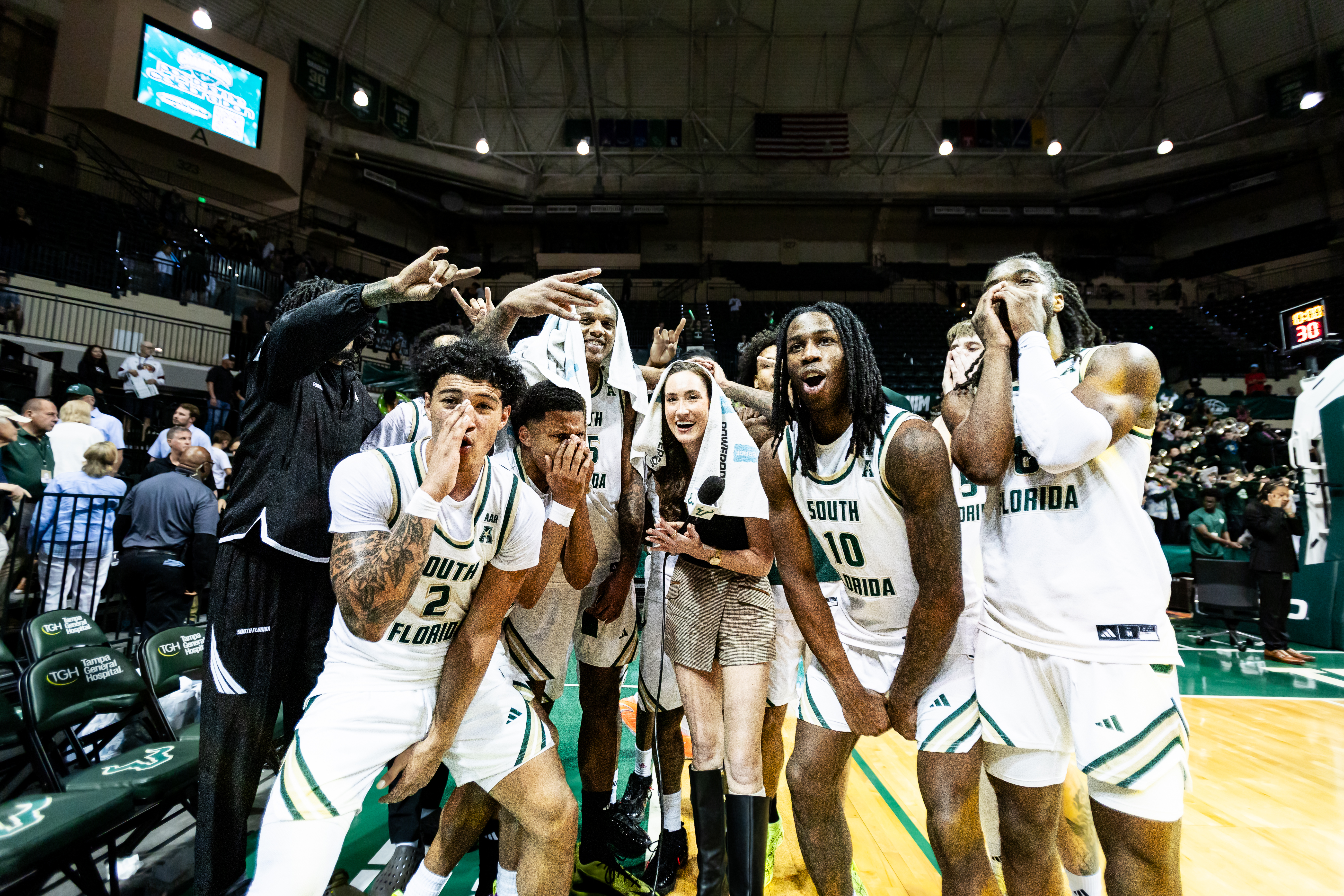
But do the Bulls need to secure some more hardware in Birmingham to punch their ticket to the Big Dance?
The short answer is yes. The Bulls will likely need the automatic bid to make the NCAA Tournament, but why is that the case?
I have yet to see a major outlet that provides bracketology put the Bulls on the right side of the bubble as an at-large bid.
Let’s talk about the numbers.
Selection metrics
The selection committee uses a plethora of different metrics and equations to create the field of 68 on Selection Sunday.
The first thing the selection committee looks at is the NET rankings of each team. The NET is a mathematical metric that weighs a team’s efficiency, who they have played and where they have played. It uses its own rankings to create a quadrant win system that weighs the quality of each team’s record.
How does the Quadrant system work?
Headed into Wednesday’s slate of games, USF was ranked 49th in the NET. This season is the first time in program history that USF has reached the top-50 in the NET.
Last season, the final four teams in the tournament were San Diego State, North Carolina, Texas and Xavier. They had NET rankings of 58, 32, 40 and 45, respectively. In 2024, Boise State (26th), Colorado (25th), Virginia (54th) and Colorado State (36th) were the last four teams in.
The NET rankings of these bubble teams vary, but where the Bulls’ résumé lacks is in Quad 1 wins. USF is 2-2 against Quad 1 opponents this season.
The second thing the selection committee uses is what they call results-based metrics. It’s a combination of a team’s Wins Against Bubble (WAB), Kevin Pauga Index (KPI) and strength of record. All of these metrics measure a team’s résumé and performance.
USF’s WAB is -1.51, which ranks 64th. Their KPI is 0.228, which ranks 35th, and their strength of record ranks 60th. If you averaged out those rankings, it comes out to 53.
In comparison, Joe Lunardi’s last team in, according to his latest bracketology, is Indiana, and their average results-based metrics ranking is 55.3.
The other equation used by the selection committee is predictive-based metrics. These include KenPom, Torvik and BPI.
The Bulls are ranked 53rd in KenPom, 54th in Torvik and 32nd in BPI. For comparison, Indiana ranks 41st in KenPom, 34th in Torvik and 64th in BPI.
To recap
The Bulls sit outside of the projected field right now first and foremost because of their NET ranking. USF, sitting at 49th in the NET, is behind six of the eight “Last Four In” teams from the past two seasons. It is also below a lot of the teams on the bubble ahead of them.
Click here for the full NET rankings.
USF will also likely have a hard time improving its NET ranking in the coming weeks. The two other teams in the American Conference ranked inside the top 100 of the NET are Tulsa at 50th and Wichita State at 84th.
The only other opportunity for USF to pick up a Quad 1 win would be in the American Conference tournament against Tulsa. The problem with that is Tulsa is right on the fringe of being a Quad 1 or Quad 2 win, and if USF loses one of the two games needed to win the American Conference tournament, there’s a strong chance the loss will come against the Golden Hurricane.
Another issue is USF’s record against Quad 3 opponents. The Bulls are 7-3 this season. Every team ahead of them in the NET has one Quad 3 loss or fewer.
Another thing going against the Bulls is their predictive-based metrics. USF’s KenPom and Torvik ratings lag behind the other teams on the bubble.
The Bulls’ results-based metrics are comparable to teams on the right side of the bubble right now, but with power conference teams getting opportunities for big wins in the final week of the regular season and in their conference tournaments, USF’s -1.51 WAB, which ranks 67th in the country, will also hurt them.
Unfortunately for USF, they played themselves out of an at-large bid earlier this season. Their early losses against George Washington, VCU and Colorado State could have flipped their résumé. Then the three conference losses they sustained by a combined five points dug their at-large bid grave.
If USF wants to make the fourth NCAA Tournament appearance in program history, they will have to do it the same way they made the Big Dance the first time in 1990: cut down the nets in their conference tournament.