
What We Learned From USF’s Blowout Win Over Delaware State
Some key takeaways from the Bulls 59-17 win over the Hornets.

For the first time in the 2026 season, the South Florida Bulls blew out their opponent. USF beat Delaware State 59-17 on Saturday night.
The Bulls are now 3-0 for the first time since 2018. USF is now 30-1 all-time against FCS foes.
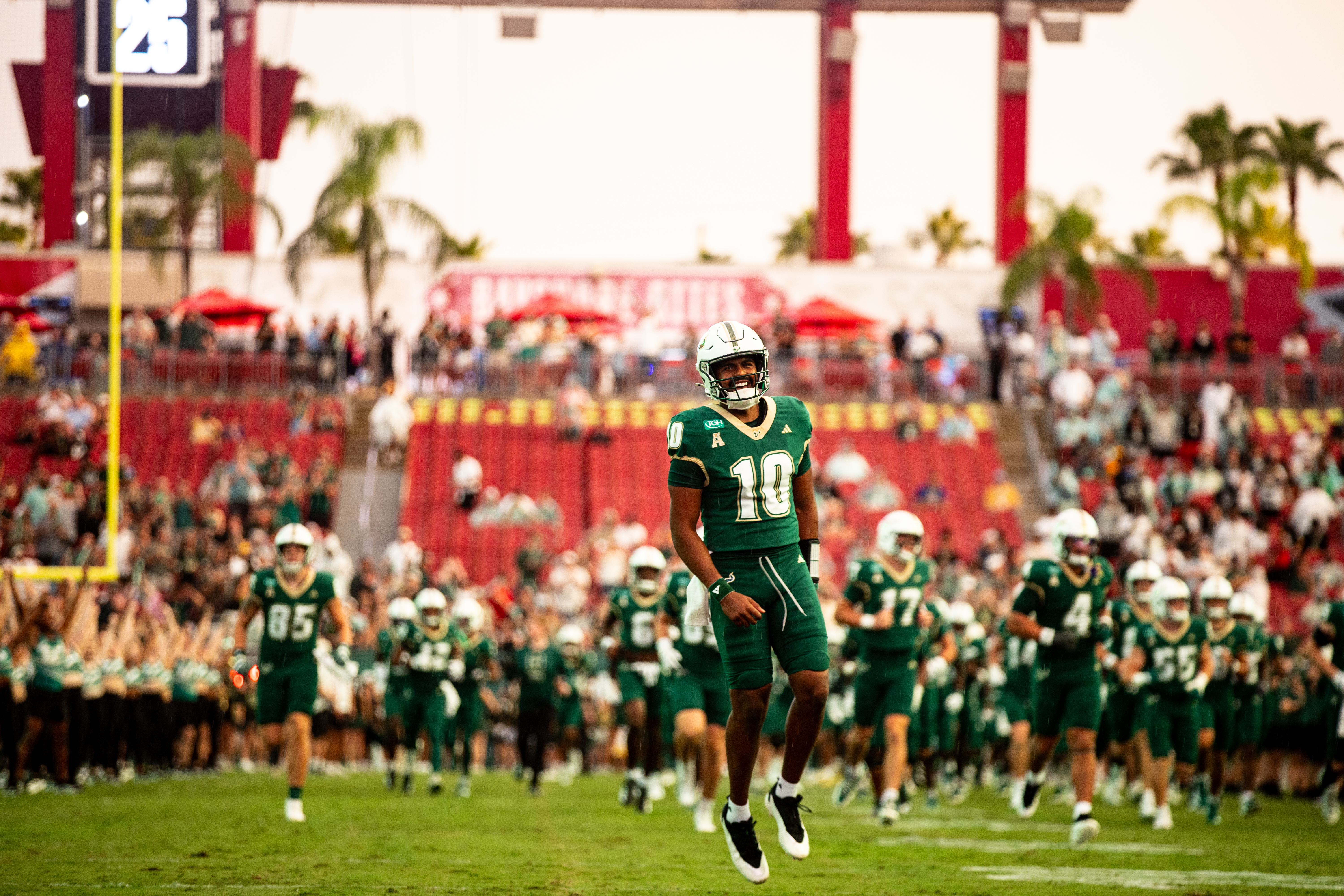
While the scoreboard showed a lopsided Bulls win, it wasn’t always pretty for USF on Saturday night. Delaware State used multiple huge plays to take advantage of a leaky USF defense and remain close on the scoreboard throughout the first half.
Between the Bulls’ lackluster play and pregame weather delays that prevented fans from parking in lots outside Raymond James Stadium until less than two hours before game time, the overall sentiment leaving Saturday night’s game wasn’t as positive as you would think for a blowout win.
USF’s pass defense struggles mightily in the first half
The most stunning thing that happened on Saturday night was Delaware State’s offensive outburst in the first half.
The Hornets scored all 17 of their points in the first half. Delaware State had 288 yards and averaged 9.3 yards per play before the halftime break.
What was most alarming was Delaware State’s success through the air. Hornets quarterback Ui Ale was 12 for 15 for 223 yards and two touchdowns in the first half. That’s good for 18.6 yards per completion. Delaware State’s 0.52 Expected Points Added per dropback is in the 89th percentile of college football, according to Games On Paper.
In DeSean Jackson’s tenure as Delaware State head coach, the Hornets have not boasted a strong passing attack. Last season, in his first season as head coach, 64.5% of the Hornets’ yardage output came on the ground.
Coming into the game, Ale was averaging 176.7 passing yards per game without playing any FBS opponents. He only had one passing touchdown and three interceptions in his three games prior to playing USF.
The Bulls’ defense was eviscerated by explosive plays in the first half on Saturday night. Delaware State had seven plays of 15 yards or more, including a 90-yard touchdown reception and a 50-yard scramble by Ale.
USF’s defense was missing major contributors on Saturday night. Starting linebackers Pup Howard and C.J. Hicks, as well as cornerback Jair Murphy, all missed the game due to injury.
The Bulls also clamped down in the second half. They shut Delaware State out and only allowed 65 total yards in the second half.
However, pass defense will be an area of concern for the Bulls moving forward. The Bulls’ passing defense is currently ranked outside the top 80 in the FBS. USF’s opponents are averaging 226.3 passing yards per game, and the Bulls are coming off back-to-back games against run-heavy offenses.
Another reason for USF’s struggles to defend the pass is its lack of pass rush. The Bulls only have three sacks in three games this season. The Bulls were able to record 18 quarterback hurries in 31 dropbacks by Delaware State quarterbacks.
However, the Bulls are still looking for their guys to get home more frequently. The only guy who did get home was senior edge rusher Marshon Oxley, who got a strip sack in his first action of the season. Senior defensive lineman Asani Redwood also had a strong performance, leading the team with five quarterback pressures on Saturday night.
USF’s run game gets going
On offense, it was the Bulls’ rushing attack that led the way on Saturday night. USF rushed for 290 yards and seven touchdowns on Saturday night.
Senior running back D.J. Crowther became the first Bull to reach 100 rushing yards in a game this season. Four other USF running backs carried the ball on Saturday night. Heading into the game, only Crowther and junior running back Jason Collins Jr. had recorded carries.
USF averaged 9.4 yards per carry against the Hornets. It’s the second straight game in which the Bulls have averaged more than five yards per rush.
The Bulls’ 0.90 Expected Points Added per rushing attempt was in the 99th percentile in college football, according to Games On Paper. Twelve percent of USF’s rushing attempts qualified as explosive runs. Delaware State only had two tackles for loss in the game.
On the flip side, the Bulls’ defense held Delaware State’s rushing attack in check. The Hornets had 103 yards rushing on 3.3 yards per carry on Saturday. They came into the game averaging 6.3 yards per rush.
The Michael Van Buren Jr. to Joshua Porter connection is elite
With how good USF’s rushing attack was, it’s easy to forget how well junior quarterback Michael Van Buren Jr. played. He completed 23 of his 32 passes for 300 yards and a touchdown. It’s the fourth time in Van Buren Jr.’s career he’s thrown for 300 or more yards.
Van Buren Jr. averaged a season-high 9.4 yards per completion against Delaware State. His 87.0 grade was tied for the best on USF’s offense, according to Pro Football Focus. Van Buren Jr. still has zero turnover-worthy plays this season.
His favorite target was junior wide receiver Joshua Porter. Following his heroic last-second touchdown catch against Army last week, Porter had his first career 100-yard receiving game and a career-high eight catches.
It’s the first time this season a USF receiver has reached 100 yards in a game. Porter is developing into Van Buren Jr.’s favorite target. He has 11 catches for 173 yards in his last two games combined.
The duo is blossoming into one of the best in the American Conference.