USF’s Loss Reveals Issues We Already Knew About
Where do the Bulls go from here after an ugly loss to Temple on Saturday night.

The saying goes, “If you play with fire, you’re going to get burned.” That rang true Saturday night for USF in its 17-13 loss to Temple.
USF’s loss was its first in 2026 and head coach Brian Hartline’s first loss as a head coach. However, the loss didn’t feel particularly different from the Bulls’ wins in previous weeks.
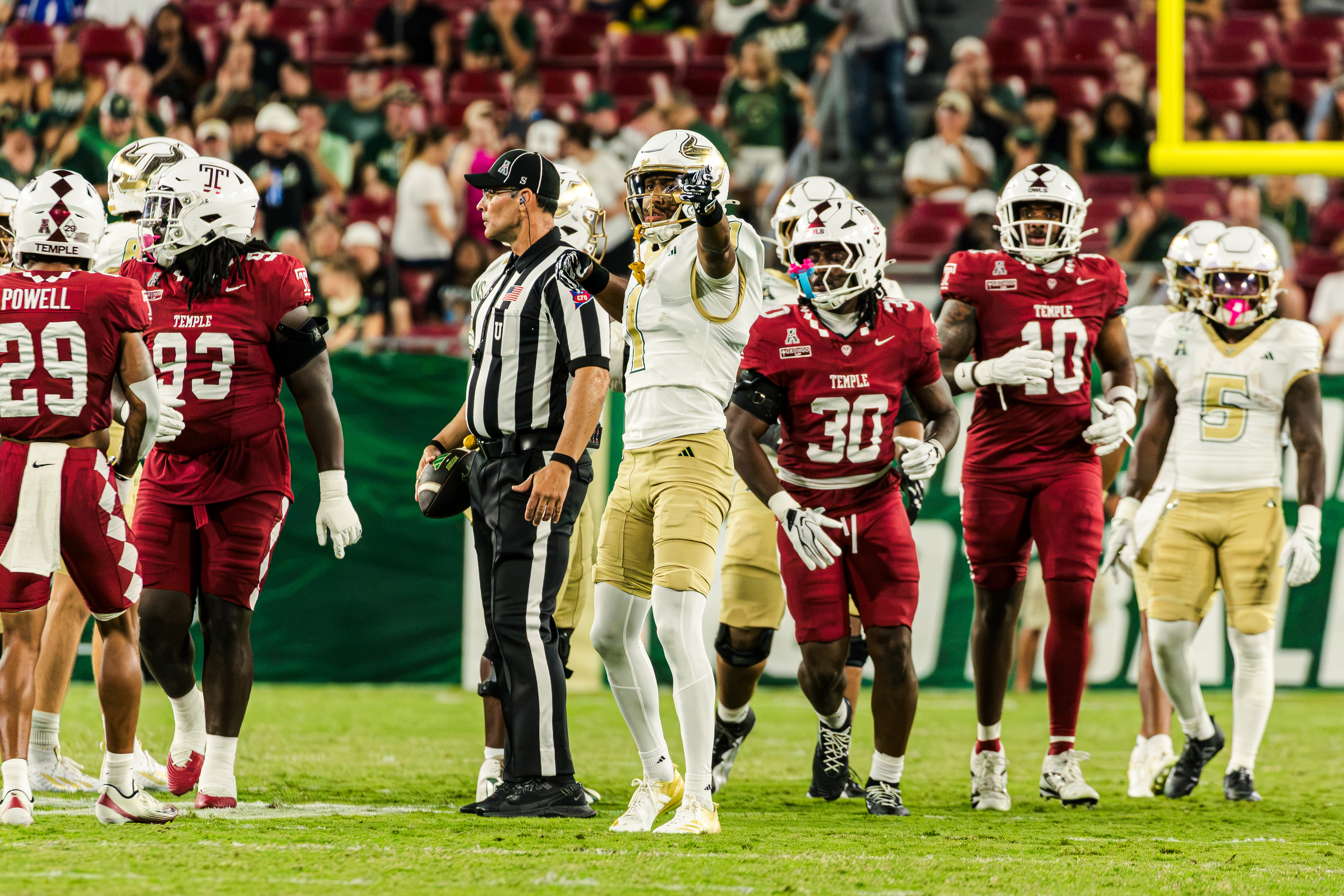
It was the second straight week that the Bulls failed to reach 20 points in a game. USF ranks 87th in the country in scoring at 26.6 points per game. The Bulls are averaging just 18.5 points per game against FBS foes this season.
Hartline described the Bulls’ offense as a “clown show” in his halftime interview. He also mentioned that USF has been “its own worst enemy on the field.”
With just one loss, the outlook for the rest of USF’s season seemingly changes dramatically. The Bulls have a short turnaround and play in the American Conference’s hardest venue Thursday night against UTSA. USF’s six remaining conference opponents have a combined record of 19-9 thus far in 2026.
But in reality, Saturday’s loss just shed light on what is a highly flawed Bulls squad.
USF’s receivers are a major weakness
A lot has been made about the Bulls’ struggles along the offensive line.
And while that is still a group that is struggling, its play improved Saturday night against the Owls. Temple had just one sack and four tackles for loss in the game.
But the problem was that while USF quarterback Michael Van Buren Jr. had more time Saturday night, there were too many plays where nobody was open.
Van Buren Jr. completed just 17 of his 32 passing attempts Saturday night. Four different receivers caught passes against Temple.
The Bulls’ leading target getter was Joshua Porter, who hauled in four catches for 48 yards. However, Porter was targeted 11 times. This season, Porter is only bringing in 56.3% of his targets. His five drops this season are tied for the second most among wide receivers in the country.
Mudia Reuben had a season-high three catches for 48 yards against the Owls on Saturday. And while Reuben has been a great story off the field with his philanthropy, he hasn’t been able to get it going on the field this season. He has only five catches through five games despite being thought of by many as one of the Bulls’ top receivers heading into the season.
Bryson Rogers also caught just four of his seven targets for 43 yards. Rogers has been consistent but still hasn’t reached 100 receiving yards in a game in his career.
The Bulls have sorely missed Arhmad Branch, who had 11 catches for 108 yards through three games before sustaining a lower-body injury against Delaware State that has kept him out the last two games.
Overall, the Bulls have a contested-catch rate of 38.9% this season. As a team, they have 14 drops this season. USF has just three passing touchdowns in five games.
Hartline had this to say about the receivers after the game Saturday:
“I think we have to vastly improve in the receiver room. It’s a trickle effect from there all the way down offensively. I think we have guys that are capable, but we are not being maximized currently in that position,” he said after the game.
Despite the struggles, the Bulls only had four wide receivers take snaps in Saturday night’s game, with one of those receivers technically being Cameron Seldon, even though he is more of a wide back.
It’s a puzzling choice for Hartline and the Bulls, especially when you take into account the number of wide receivers USF recruited through the transfer portal this offseason.
If Hartline knows anything, it’s how to develop wide receivers. And he’s going to get more out of his group moving forward if the Bulls want to jolt their offense.
USF’s defense will continue to keep them in games
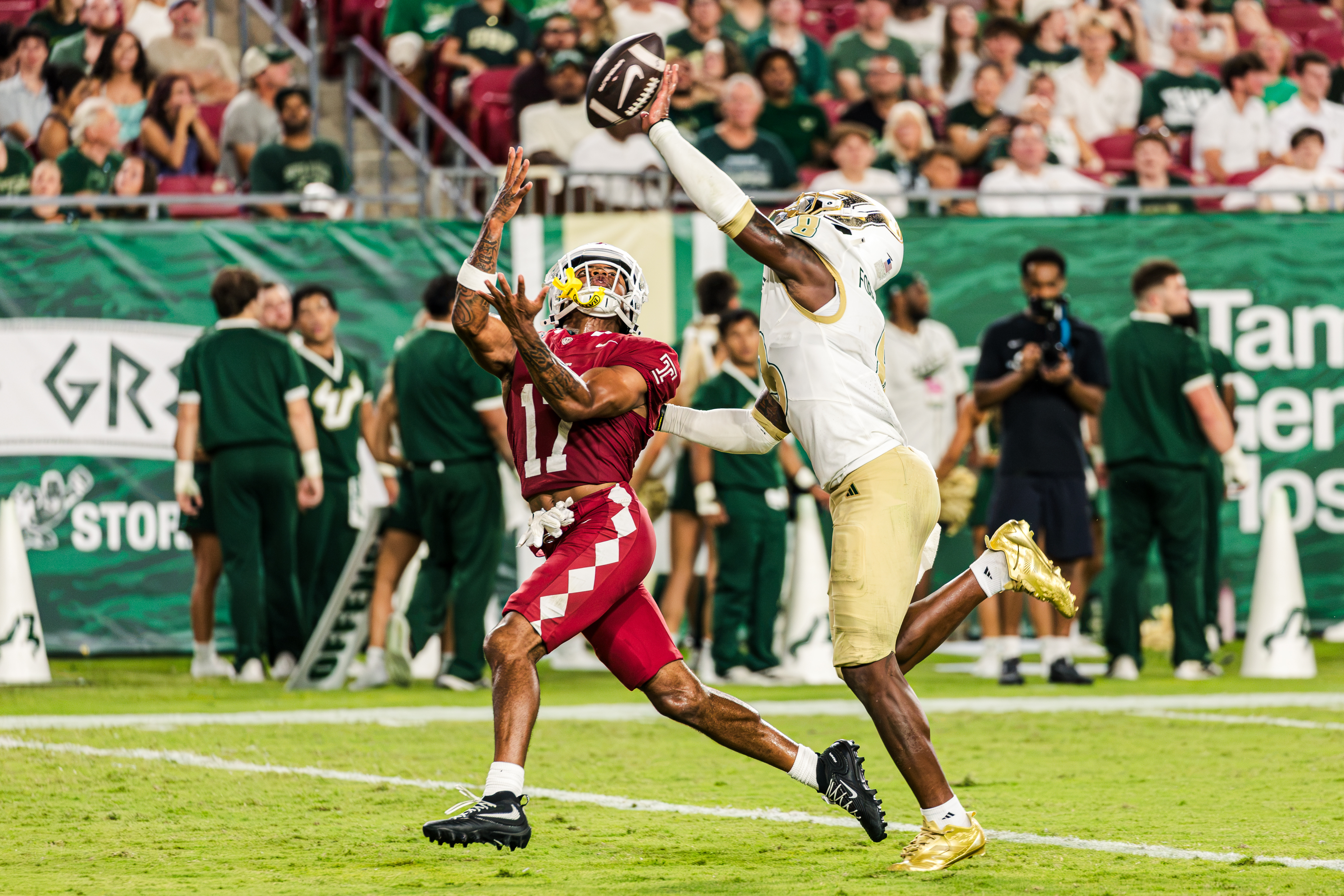
The Bulls’ defense has been as good as the offense has been bad this season.
USF has held opponents under 20 points in four of its five games this season. The Bulls now rank 19th in the country in scoring defense.
The Owls had just a 32% success rate Saturday night. USF did a good job of slowing down a prolific rushing attack, holding the Owls to negative expected points added per rush.
The biggest problem for the Bulls’ defense Saturday night was Temple quarterback Ajani Sheppard’s legs. Sheppard led the Owls with 87 rushing yards and three rushes of 10 yards or more, including the game winner, which was a 34-yard scamper.
Still, the USF defense did more than enough to lead the Bulls to a win.
One positive sign from Saturday’s game was the emergence of two of the Bulls’ defensive captains.
Grayson “Pup” Howard had a career-high nine tackles and added a tackle for loss. Howard missed two games this season due to injury after getting hurt early in the Bulls’ season-opening win against FIU. However, Saturday, Howard was a force along the Bulls’ defense and had one of the best games of his four-year college career.
C.J. Hicks also had a career-high seven tackles Saturday night. One of his tackles came when he lined up along the line of scrimmage as a pass rusher and brought Sheppard down near the line of scrimmage for a de facto sack.
The Bulls’ pass rush as a whole has picked up in their last two games. They have five sacks and 41 quarterback pressures combined against Bowling Green and Temple. USF had three sacks and 46 quarterback pressures combined in its first two games.
USF also held Temple to just three points in the red zone on two trips Saturday night. Temple’s third-quarter fumble marked the first time in 2026 that it hasn’t cashed in with points in the red zone.
What happens next for USF?
It’s hard to leave this game feeling overly positive about USF moving forward in 2026.
The Bulls’ offense has shown little signs of improvement, and their schedule is only going to get harder moving forward.
And on top of that, there seem to be real signs of dissension within USF’s locker room. Hartline and Hicks both called out the team in their postgame press conferences Saturday.
“We are definitely our own worst enemy on the field. There’s no doubt about that. I’m going to leave it at that. I have a little bit of a hunch of why that may be, but we got to grow up quick,” Hartline said.
“I feel like us as a team, we’re more relaxed. I’m not going to say who, but some of the guys in the locker room were like, ‘Oh, we’re a second-half team, you know, we’ll be fine.’ It shouldn’t be like that. We need to come out like that all four quarters,” Hicks said.
A lifeless offense, a contentious locker room, and a fan base that is unsatisfied with the brand of football being played.
Hartline and the Bulls need to rally quickly, or the 2026 season could get off the rails quickly.