
USF’s coaching conundrum: How should the Bulls approach new hires?
What should Rob Higgins priorites be when hiring new head coaches moving forward?

South Florida CEO of Athletics Rob Higgins has surely been busier hiring new coaches in his first seven months than he would have liked.
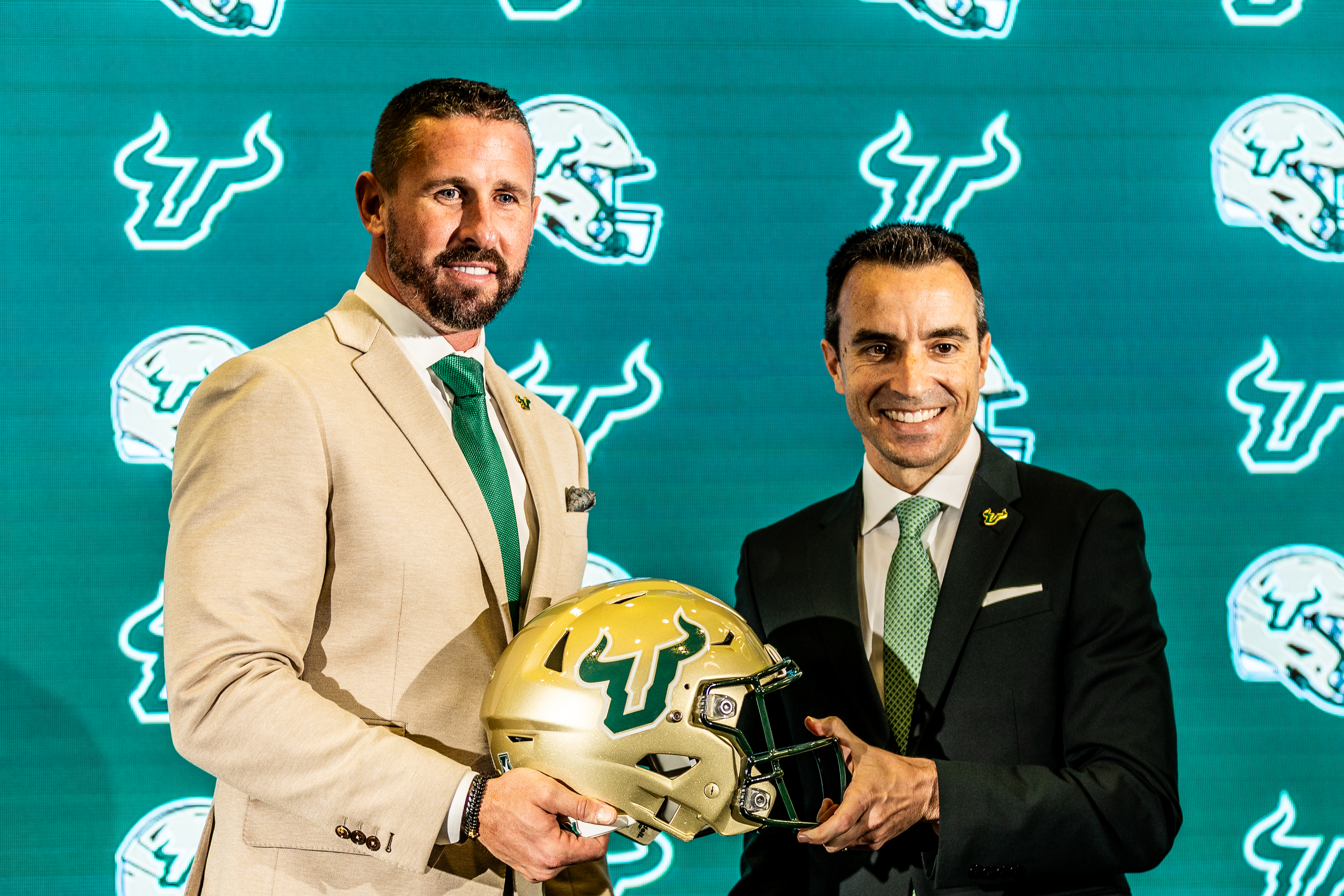
Higgins has hired new football and soccer coaches and is in the process of filling openings for the Bulls’ men’s and women’s basketball teams.
When Higgins took over in September, the Bulls were in the midst of their most successful football season in nearly a decade. His reward? Alex Golesh leaving USF for Auburn immediately after the season ended.
Fast forward to March. Bryan Hodgson leads the Bulls to a conference regular-season and tournament title for the first time in program history. How does it end for Higgins and USF? Hodgson leaves to take the head coaching job at Providence.
There’s no denying the Friars have a richer history than USF. Providence has 22 NCAA Tournament appearances to USF’s four. It has reached the tournament’s second weekend eight times and made the Final Four twice. The Bulls have never made it past the round of 32.
However, the move still felt like a slap in the face to many Bulls fans. Not a slap in the face in the sense that Hodgson disrespected the university or its fans. No — it was more like the slap in the face of someone waking you up from a daydream.
It reminded many that the “S” in USF still stands for stepping stone.
Both Hodgson and Golesh were high-risk hires.
Golesh had no experience as a head coach and only two years of collegiate play-calling experience before arriving in Tampa. Not to mention, he brought with him an unorthodox, high-tempo, no-huddle offense.
Hodgson came with his own set of questions. He had just two years of head coaching experience under his belt. While he racked up back-to-back 20-win seasons at Arkansas State, Hodgson wasn’t able to break through and win a conference tournament until this season with the Bulls.
For both hires, former USF athletic director Michael Kelly identified qualities in on-field or on-court tactics and culture-building that translated into program-morphing regimes. They were young coaches on the rise who chose USF as a starting point to potentially ambitious careers (although Hodgson was much more successful in big games than Golesh).
However, just as both coaches seemed to be turning the corner on creating consistent programs that could compete at the top of the American Conference — and even nationally — they left for other jobs, leaving USF searching for someone who can quickly grasp their predecessors’ momentum before it gets snuffed out.
College sports are going through more change from season-to-season than ever. But can USF sustain program success if that success leads to a coaching change every one-to-three years?
Higgins seems to think so.
He hired 39-year-old Brian Hartline to become USF’s next head coach in December. It will be Hartline’s first time as a head coach, and if he finds success, he will likely become a hot name for Power Four conference openings. He reportedly garnered interest from Power Four schools over the past couple of seasons before taking the job with the Bulls.
USF currently invests more in its athletics programs than most Group of Five universities. It is the only non-Power Four school to fully fund the $20.5 million athletic NIL revenue-sharing limit. The Bulls are positioned to construct rosters across multiple sports that many teams in the American Conference cannot afford.
But they still aren’t a power conference program. And until that changes, their successful coaches will always be attractive candidates for Power Four job openings.
That begs the question: Should USF consider a coach’s long-term commitment to the university when making a hire? Should the Bulls pass up on top candidates for someone more likely to stay long term?
Before you answer, consider the Utah State men’s basketball program.
The Aggies have had four different coaches since 2018 and three in the past four seasons. Craig Smith, Ryan Odom, Danny Sprinkle and Jerrod Calhoun all made NCAA Tournament appearances during their time at Utah State. The Aggies have six tournament appearances and three Mountain West regular-season titles since 2018.
Utah State has significantly more basketball history than USF, with 26 NCAA Tournament appearances in program history. However, its recent blueprint is something that can be acknowledged when discussing USF’s philosophy on hiring coaches.
At the end of the day, Higgins and his staff are the ones making the decisions. Judging by the Hartline hire, it seems USF will continue to target young coaches rising up the ranks — coaches who may ultimately lead the Bulls to make another hire sooner rather than later.
But can they sustain success while making hires this frequently?
Only time will tell.